Still getting around: Beach Boys fire up Hard Rock
HOLLYWOOD ― “It was a rough night,” Mike D’Amico sighed as he poked through the offstage drapes to deliver a couple of passes to waiting friends at Seminole Hard Rock.
No chance to explain, only to say before returning to his dressing room that he hoped to make it home to Lake Worth “sometime in September.”
But any reason is plausible, since D’Amico is adopted: He’s a member of perhaps the most dysfunctional family in show biz history, and therefore a key element of The Beach Boys 50, this time on bass.
The experience is hardly alien or alienating to D’Amico, who’s been involved with the Brian Wilson wing of the family for nearly 15 years. Previously he performed as a drummer.
But then D’Amico was made for these times. As a member of the Wondermints, a Los Angeles-based power-pop band, he can play just about any instrument. Some of the band’s music has a Beach Boys ring to it, so when Wilson hit the road in 1999, he took them along. Several more tours and recording sessions followed.
But just like the crowds come and go at any surf beach, so, too, has the Beach Boys lineup shifted over the decades. God only knows how many individuals have actually been “Beach Boys” while recording more top 40 hits (36) than any other American band.
In the beginning (1959) were the Wilson brothers ― high schoolers Brian, Carl and Dennis ― with cousin Mike Love as “Carl and the Passions.” Al Jardine came on board and The Pendletones were born in 1961, only to die when Candix Records changed the label on their first record, Surfin’, to The Beach Boys. On New Year’s Eve 1961, they played a Richie Valens memorial show, following Ike and Tina Turner. Two months later, Jardine quit, and two months after that, David Marks, then 13, signed on.
In 1963, Jardine returned and Marks left. Glen Campbell joined in 1964 and was replaced by Bruce Johnston in 1965. Other notables included Daryl “The Captain” Dragon and Toni Tennille, Carl’s brother-in-law Billy Hinsche (Dino, Desi and Billy), actor John Stamos and John Cowsill (of the Hair-y Cowsills).
Over the years, as Carl and Dennis died, Brian battled psychological and chemical demons, and members sued members, Jardine (fired from the band in ’98) and Love launched their own touring bands. Johnston hung around most of the time, and in 1997 Marks returned for a couple of years and was officially recognized as an original Beach Boy before leaving two years later to battle hepatitis C.
Twisting here, stretching there, The Beach Boys easily could have been the rubber band. That stint with Glen Campbell, for example, evolved from his session work with the band that actually played the instruments on some of the Beach Boys hit records.
Campbell, among others including Leon Russell, was part of The Wrecking Crew, a talented but unheralded group of studio musicians. They were mostly well-known for providing instrumental work for the likes of The Monkees, Carpenters, the early Byrds, Simon and Garfunkel, even Frank Sinatra and Elvis.
That telltale intro to Good Vibrations? The Wrecking Crew. The original Beach Boys could play, but The Wrecking Crew could play anything – rock, pop, jazz, rhythm and blues – and play it better.
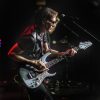
Fast-forward half a century: Brian’s interview on CBS Sunday Morning the week before the group’s May 4 concert at the Hard Rock Live in Hollywood had viewers wondering if he was capable of playing anything. Definitely not the sharpest pin in the cushion, yet with a little help from his friends, he played piano and even plucked a few notes on a bass and tried a few steps with lead guitarist Jeff Foskett.
Meanwhile, D’Amico was on the back riser carrying out the serious bass line. The Wondermints were there, and elements of Love and Jardine’s splinter bands – a wacky family reunion of sorts. Just as The Wrecking Crew did in the ’60s, this bunch was there to bring that sound to life.
It’s all about the music, and what a celebration it was when they did get to South Florida, beginning with Jardine’s invitation to “get together and do it again.” The joint never stopped rocking. In remarkable harmony (even Brian),with rousing falsetto by Foskett, they romped in rough chronological sequence through surfing songs, high school angst and romance and hot rods. Love’s banter provided context, for example, explaining to the youngsters in the house the meaning of “flip side.”
Be True to Your School. Fans dressed as cheerleaders with pompoms dance in the center aisle. Wouldn’t It Be Nice? Everyone is on their feet, singing along and batting beach balls.
Tributes to the late brothers follow: a video screen shows clips of an eerily Lennonesque Dennis singing Forever and Carl offering the plaintive God Only Knows. Taking cue from his brothers, Brian sums up the evening with his new single, That’s Why God Made the Radio:
So tune right in, everywhere you go
He waved His hand, gave us rock ‘n’ roll
The soundtrack of falling in love
That's why God made the radio
Making this night a celebration
Spreading the love and sunshine
To a whole new generation
Whole new generation
After an exhaustive 40 songs, they left the stage, only to return with Bruce Johnston declaring, “It’s the weekend; we can stay later,” and close with Kokomo, Good Vibrations and Fun, Fun, Fun.
Back to reality. There’s no place “off the Florida Keys” called Kokomo, and Daddy didn’t take the T-Bird away: Ford quit making it. But even if Brian’s launch of Good Vibrations was a bit rough, the Beach Boys have proved they still can get around.
SET LIST (May 4, 2012)
1. Do It Again
2. Catch a Wave
3. Don’t Back Down
4. Surfin’ Safari
5. Surfer Girl
6. You’re So Good To Me
7. Wendy
8. Then I Kissed Her
9. The Little Girl I Once Knew
10. Why Do Fools Fall In Love
11. When I Grow Up To Be A Man
12. Cotton Fields
13. Be True To Your School
14. Disney Girls
15. Please Let Me Wonder
16. Don’t Worry Baby
17. Little Honda
18. Little Deuce Coupe
19. 409
20. Shut Down
21. I Get Around
22. California Dreaming
23. Sloop John B
24. Wouldn’t It Be Nice
25. This Whole World
26. Forever
27. Sail On Sailor
28. Heroes and Villains
29. In My Room
30. All This Is That
31. I Just Wasn’t Made For These Times
32. God Only Knows
33. That’s Why God Made The Radio
34. California Girls
35. All Summer Long
36. Help Me Rhonda
37. Rock and Roll Music
38. Do You Wanna Dance
39. Barbara Ann
40. Surfing U.S.A.
41. Kokomo
42. Good Vibrations
43. Fun, Fun, Fun
THE BEACH BOYS
Original Members:
Mike Love, lead vocals
Brian Wilson, vocals, keyboards, bass
Al Jardine, vocals, guitar
Dave Marks, vocals, guitar
Bruce Johnston, vocals, keyboards
Supporting musicians:
The Wondermints:
Mike D'Amico - bass, drums, vocals (2012)
Probyn Gregory - guitar, horns, bass, theremin, percussion, vocals (2012)
Darian Sahanaja - keyboards, mallets, vocals (2012)
Nick Walusko - guitar, vocals (2012)
Scott Bennett - keyboards, guitar, vocals (2012)
Nelson Bragg - percussion, vocals (2012)
John Cowsill - drums, vocals (1999-present)
Jeff Foskett - guitar, mandolin, percussion, vocals (1981-1991,2012)
John Stamos - percussion, guitar, vocals (1988-2012; select shows, not Hollywood)
Scott Totten – music director, guitar, vocals (2001-present)
Paul von Mertens - woodwinds (2012)
Handsome, beautifully staged ‘Romeo’ ends FGO season in style
The ultimate success of an opera or of a production finally comes down to the music – whether it’s good enough, in the first place, and in the second, whether it’s been sung well.
But something needs to be said now and again about a good staging. Although Florida Grand Opera has had many fine directorial hands at work over the years, its current production of Charles Gounod’s Roméo et Juliette, which closes tonight, is easily the smoothest and most seamless staging of an opera I’ve seen this company do.
Director David Lefkowich has carefully considered every part of this sometimes-creaky 1867 French opera and made every piece of business in it work, and work well. It’s a pleasure to watch, continually engaging and entertaining, and its conceits always have a justification in the text and supplement the drama rather than drowning it out.
The other good news is that the two leads in this production, Mexican soprano Maria Alejandres and French tenor Sébastien Guèze, have plenty of youthful singing strength and acting chops to spare, and they make an attractive and believable couple.
Alejandres, who sang Lucia for Palm Beach Opera’s Lucia di Lammermoor in March and will return to FGO next season as Violetta in La Traviata, has a big, clarion voice with a high register of impressive power and a pleasantly dark overall color. Her acting was credible at all times, even down to her slow, shuddering expiration next to her dead husband in the family crypt. Juliette is one of Alejandres’ favorite roles, and it showed.
Guèze has an even more taxing time of it, and he was every bit as excellent, singing with uninterrupted stamina, a large voice that moved smoothly between registers, and one that was persuasively enamored rather than over-excited. He and Alejandres blended well vocally, particularly in the Nuit d’hymenee duet in the bridal bed, and he was agile enough to fall dramatically from the tomb slab as the poison overtook him in the work’s final pages.
Fine supporting came from American mezzo Cindy Sadler in a minor role as Gertrude, the nurse; she has a rich and distinctive voice, and she was charming in a bit of good stage business involving a gang of Capulet roughs and a sword. The American tenor Daniel Shirley, an excellent Prunier earlier this season in Puccini’s La Rondine, was a good Tybalt, and in his short time on the stage his cutting, high-profile voice could be heard to fine effect.
Baritone Jonathan G. Michie was a capable Mercutio, though his Queen Mab song (Mab, la reine des mesonges) was somewhat on the slow and poky side, and didn’t have enough of the lightness and whimsicality it needed. Bass-baritone Craig Colclough, as Frère Laurent, sang with a fine sense of legato line and a good feel for the style of this music. But his voice, while attractive, needed to project more to make a weightier impact, and the same goes for bass-baritone Stephen Morscheck as Count Capulet, and baritone Joo Won Kang as the Duke of Verona.
Mezzo Courtney McKeown brought a sweet, pretty voice to her Stephano, though her Que-fais tu, blanche tourterelle would have benefited with some additional characterization so that the audience could really feel the song’s goading edge.
FGO’s chorus, directed by John Keene, deserves high marks for its work throughout the opera; many of the choral moments can sound tedious or corny if not sung with conviction and an understanding of Gounod’s style. But thankfully, that was not the case here, with the chorus singing everything from the opening prologue material to the cries of Justice! in the duel scene with precision and well-rounded vocalizing.
One of the best things about this production is the conducting of Kentucky Opera’s Joseph Mechavich, who led the proceedings superbly. Tempos were beautifully judged, and the orchestra played wonderfully for him. You rarely hear this score with the kind of big-boned force with which Gounod wrote it, but Mechavich let it rip, with first-rate results.
Of particular note was the playing of the cellos, who made so much of the returning love music without overdoing it; in short, Mechavich and the orchestra let Gounod be Gounod, and while the score may not have the harmonic imagination of Bizet or the flagrant imagination of Berlioz, it works perfectly well within its strictures, and it was gratifying to hear it be given without apology.
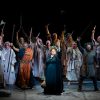
This is a handsome and beautiful production, borrowed from the Minnesota Opera where Lefkowich first created it. One of the most affecting things was the subtle way dance and motion were used to carry the plot along, such as in the wedding bed scene, where Romeo watches a pantomime of the deaths of Mercutio and Tybalt, occurring over and over again, and unwinding backward. It’s a brilliant effect, as are the photographs of statuary, including the Virgin Mary, that are projected over the set at key moments in the score.
Other fine bits of stagecraft could be seen in the duel scene, where each side of the conflict moves in motion, swords at the ready, to jump in when the time is right, and then hold back. It is at once a corps de ballet move and a fine expression of coiled tension, and it’s highly exciting. There are no moments where Lefkowich hasn’t thought out exactly how he wants it to look, and yet it never seems over-inventive or distractingly busy.
It simply flows, with multiple moving parts that give the audience plenty to take in throughout a long evening of more than three hours, but with the orchestra, conductor and singers making the score a living, breathing thing, it works marvelously well as a conservative, yet fresh, take on this fine opera and classic story.
Roméo et Juliette closes tonight at Fort Lauderdale’s Broward Center for the Performing Arts. Curtain time is 8 p.m., and tickets range from $21 to $200. Call 800-741-1010 or the Broward Center at 954-462-0222.
School of Rock brings band, dreams to Philly, Cleveland
For every kid who learns to play an instrument or sing (or both) in hopes of joining a rock band, the Rock and Roll Hall of Fame is the pinnacle.
Just ask the Red Hot Chili Peppers, who formed in Hollywood, Calif., in 1983 -- the same year the hall was established in Cleveland -- and got enshrined during its 27th annual induction ceremony last month.
But even for the members of the Chili Peppers, playing at that ceremony was likely still only a dream halfway through their 30-year career. For the 13-to-17-year-olds in the advanced School of Rock North Palm Beach Houseband from Palm Beach Gardens, playing at the hall is a dream that will come true on July 7 to highlight a special tour through Philadelphia and Cleveland.
Most of the band members, and a handful of parents and chaperones, will see the hallowed hall for the first time. Notable exceptions will be 13-year-old guitarist, vocalist and bassist Ben Rothschild and father Rick Rothschild.
A 49-year-old keyboardist who runs an ink-and-toner business, the elder Rothschild also co-owns both the School of Rock’s 4-year-old North Palm Beach site and its 2-month-old, suburban Lake Worth-based South Palm Beach location with 46-year-old psychologist (and guitarist) Chris Paige.
“I wouldn't miss this for the world,” Rick Rothschild says. “I'll take the tour bus up with the band, and Chris is flying up. It’s been a dream of mine to take the kids to the Rock and Roll Hall of Fame ever since Ben and I visited, since we spent days there. The exhibits change constantly, and there are all kinds of things to look at, from lyrics to costumes to movies.
Every day there, it looked different. To be able to show these kids the history of rock and roll, and have them play there, is amazing.”
Joining Ben Rothschild, on the bus and onstage, will be vocalists Lexie Ayres and Clarissa Schmidt; guitarists Doug Benilous, Austin Covell, Dylan Fernandez, Tommy Hickey and Rob Hickey; keyboardist Alex Burgess, violinist Caitlin Trezise, bassist Zoe Zeeman, and drummers Andy Haas, Tyler Kulik, and Alex Mandel.
“We’re so excited; we can’t wait,” says Ayres, a 15-year-old Lake Worth resident who’s also learning to play keyboards. “Myself, Clarissa and Caitlin, when she isn’t playing violin, will sing lead, along with some others. To be able to see the Rock and Roll Hall of Fame for the first time, and to actually perform there, is such a great opportunity.”
Most band members will play one or more instruments, do some singing, and rotate through onstage lineups that range between four and eight members. And for most, this will be their first tour of any kind. Thanks largely to the ever-growing list of School of Rock locations, which now approaches 90 in 30 different states and Mexico, the North Palm Beach Houseband will play two shows each in Philadelphia and Cleveland with other house bands and regional all-star lineups.
“What better place to play on the Fourth of July than Philadelphia?” Rothschild asks. “The details haven’t been finalized yet, but the owner of the Philly school is organizing a festival and another gig for July 4 and 5. The second gig in Cleveland will be a charity event on July 8, with School of Rock house bands from Ohio and Michigan, plus the 2012 School of Rock Midwest AllStars. And we’re just planning our song lists for the shows. When we’re in Cleveland, we’ll certainly do a little tribute. Maybe some Mott the Hoople.”
Four members of the North Palm Beach Houseband -- guitarists Benilous and Fernandez, bassist Zeeman and drummer Mandel -- were recently selected among the best in their region and named 2012 School of Rock South AllStars.
“I’ll be able to go on my first two tours this summer,” says Fernandez, a 17-year-old from Boynton Beach who also sings and plays bass, keyboards and drums. “I'm so psyched to play in Philly, and finally see the Rock and Roll Hall of Fame, and especially to play there. The South AllStars will tour up the East Coast starting in late July, and play Warped Tour stops in South Florida and Atlanta.”
Philadelphia is where manic guitarist Paul Green started the first School of Rock in 1998 before selling the chain a few years back. He was the inspiration for Jack Black’s character in the 2003 film School of Rock, and he appeared in a stellar 2005 documentary on the franchise called Rock School.
With a motto of, “Inspiring Kids to Rock On Stage and In Life,” the schools offer weekly private lessons that revolve around school homework and other responsibilities. There’s open, rolling admission, no auditions, and reasonable tuition to learn an art that public schools largely ignore. And students are placed in band situations according to their age and skill
levels, which literally run from A to Z (as in AC/DC songs for younger kids in the beginning Rock 101 program to advanced Frank Zappa material for all-stars).
“There’s also a not-for-profit program being set up called ‘Rock the Future,’” Rothschild says, “to allow inner-city and other kids who can’t afford to attend a School of Rock to be able to do so.”
In addition to the upcoming tour, Rothschild has future plans to introduce students to the realities of road work.
“I want to expose these kids to what it's like,” he says. “We’ll live in hotels like a band for 10 days. The kids will either be playing or on the bus for the entire time, but we’ll only stay a half-mile or so from the Rock and Roll Hall of Fame. So we’ll walk over there in the morning, spend the entire day exploring before they play there, and then hang out with the local kids. And if this goes as well as I think it will, we might hit places like New York and Nashville as early as next summer.”
Both Rothschild and Paige have been frantically getting the new South Palm Beach school (www.southpalmbeach.schoolofrock.com) up and running while organizing the tour and putting on an impressive slate of shows by the North Palm Beach school (www.northpalmbeach.schoolofrock.com). The Lake Worth site’s debut concert, at its 200-capacity Dark Side Theater, will be Pink Floyd’s The Wall on June 9 and 10. The Palm Beach Gardens school has no such theater, so it makes good use of the facility to the south, along with other area venues.
A variety of North Palm Beach students will perform in the upcoming “Tribute To ’80s Metal” (at 8 p.m. on May 18 at the Dark Side Theater, and 3 p.m. on May 19 at B.B. King’s in West Palm Beach), as well as the “Tribute To Punk Rock” (8 p.m. on May 19 at the Dark Side; 3 p.m. on May 20 at B.B. King’s), “Tribute To One-Hit Wonders” (8 p.m. on June 1 at the Dark
Side; 3 p.m. on June 2 at B.B. King's), and “Tribute to Seattle's Best Rock” (8 p.m. on June 8 at the Dark Side; 3 p.m. on June 9 at B.B. King’s). The northern school also has one-and-two-week Summer Camps in June, July and August.
Needless to say, the cost of executing a 10-day tour is daunting between the tour bus rental (which includes costs for insurance, gas and a professional driver) and additional money for food and lodging.
“It’s very expensive,” Rothschild says. “In most of our shows, any money we make goes toward paying the musical director and for wear and tear on our equipment. We’ll be putting on Battle of the Bands shows to raise tour funds, and parents from both of our schools are pitching in, which is great.”
***
The School of Rock North Houseband performs a special “Walk of Fame” fundraising concert from 6-8 p.m. on Saturday, May 12, at the Dark Side Theater at the School of Rock South, 7433 S. Military Trail in Lake Worth. Advance tickets cost $25, and are suggested and available by calling School of Rock South Palm Beach general manager Mary Mandel at 561-420-5652.
Adams classic leads challenging Firebird program
There are at this point only a relatively small number of 20th-century American compositions that have entered the repertory on any kind of permanent basis.
But two of them were on an all-American program presented by the Firebird Chamber Orchestra on Thursday night at St. Gregory’s Episcopal Church in Boca Raton. And the third piece on the program is attractive enough to already have made the rounds a good bit and made a strong name for its composer.
This was the final concert in the season by the Firebird, which is the orchestral arm of the Miami-based Seraphic Fire professional choir. As is usual for this string orchestra, violins and violas played standing up, which lends an air of engagement and excitement to the music.
The shorter of the two longer pieces on the program was Christopher Theofanidis’ Visions and Miracles, a three-part work from 2002. This is a pleasant and skillfully composed work, with minimalist orientation but a much stronger sense of melody than standards of the genre; in addition, Theofanidis writes with a harmonic sensibility akin to pop, with the same kind of basic-but-inevitable progressions.
The first movement, All Joy Wills Eternity, starts with a mixed-rhythm chugging that gets topped by a rising motif that slides up as it goes higher. Conductor Patrick Dupré Quigley kept things cooking along with a tight beat, and the strings played with clarity and precision; indeed, the music gained by the small forces here in that it sounded more like a band trying something out and not an implacable rhythm machine shutting out all other ideas.
The second movement (Peace Love Light YOUMEONE), built, as Quigley told the smallish house, on the seven notes of the scale, was carefully and movingly played, and there was a gratifying change of string color when the violins start with one simple note change to play the middle of a different scale than the one they started with. The final rising scale in the violins in the last measures was not quite in tune, which marred the effect somewhat.
The vigor of the finale (I Add Brilliance to the Sun), with its appealing syncopations and descending scales, was forcefully communicated by the ensemble, which appeared to be having a good time. This is a most effective and genial piece of contemporary music, and helps explain this composer’s significant popularity.
A much more ambitious piece, and one of the classics of minimalism, followed in the shape of John Adams’ Shaker Loops. This was a fine performance of this demanding piece, which is much less ingratiating than the Theofanidis. Quigley did a wise thing by explaining that the music requires a different kind of listening, compare changes in the unbroken sound fields to the sudden appearance of fireflies on a dark summer night.
Expert ensemble was critical for this piece, and the Firebird musicians complied, keeping up a huge amount of tension in the first movement (Shaking and Trembling) from the first bars to the sudden change near the end. The three cellists and the bass player were particularly good at their entrance, and were much assisted by the resonant St. Gregory’s acoustic, which magnified their sound.
Hymning Stews, the second movement, was full of atmosphere, with a slightly melancholy tonal backdrop through which wistful sighs and cries shot in and out. It was very effective, especially because the musicians have to maintain constant tension throughout.
In the third movement (Loops and Verses), the transition to a faster pace was introduced by some lovely cello playing on a few notes that in a different composer’s hands might have been the place to introduce a long-breathed melody. But that’s not what Adams was after here, and the slow acceleration and build into an aggressive, even ferocious, climax was beautifully managed by Quigley and the orchestra, which again sounded like a much larger group thanks to the church acoustic.
The last movement (A Final Shaking) maintained the work’s dramatic narrative, even though that’s just inherent in the repeated patterns, and brought it to its quiet expiry with skill. Much of the audience was very cool to the piece, though surely not the playing, and it was something of a risk to offer it. But it was very well done, particularly for such a small ensemble, and a good representation of what Adams and American minimalism are all about.
The concert opened with the string orchestra version of the Hoe-Down from Aaron Copland’s Rodeo. A staple of American classical music and a proven crowd-pleaser, the Firebird gave it plenty of energy and fire. Most of the time it sounded somewhat off-kilter, though, and could have used a stronger sense of the basic pulse.
***
The Firebird Chamber Orchestra plays this program again this afternoon at the Miami Beach Community Church in Miami Beach. Tickets for the 4 p.m. performance are $35. Call 305-285-9060 or visit www.seraphicfire.org.
Manzarek-Rogers are hit-and-miss at Bamboo Room
On paper, a band co-led by former Doors keyboardist Ray Manzarek and former John Lee Hooker slide guitarist Roy Rogers might not seem likely.
But when their common agent suggested the pairing, the two collaborated on their 2011 debut CD Translucent Blues (Blind Pig), a dark yet accessible take on modern blues-based musical structures.
After all, the 73-year-old Manzarek was born on the bluesy south side of Chicago before he moved to Los Angeles to launch the psychedelic Doors with vocalist Jim Morrison, guitarist Robby Kreiger and drummer John Densmore in 1965. And the 61-year-old Rogers, who worked with Hooker through the '80s, is a native Californian who recently played with acidic bluegrass icon Dan Hicks at his 70th birthday concert in San Francisco.
Each co-leader was a support vocalist with their famous entities, yet they split lead vocals with the Manzarek-Rogers Band. On Translucent Blues, studio effects and multi-tracking strengthened Manzarek's lower-register growl and Rogers' higher-pitched, more nasal delivery. But without those enhancements, the vocals proved the weakest aspect of their performance before a capacity crowd at the Bamboo Room in Lake Worth on Friday.
Backed by Elvin Bishop bassist Steve Evans and drummer Billy Lee Lewis, from Rogers' Delta Rhythm Kings band, Manzarek opened the show by singing Hurricane, the first track from Translucent Blues. With lyrics by The Basketball Diaries author Jim Carroll, the track set the tone for the entire concert -- a mid-tempo blues number with pitch-challenged vocals, Manzarek playing only acoustic piano sounds on a lone Kurzweil keyboard (which had the capacity for his signature Farfisa organ and electric piano tones), and Rogers impressively sliding around his customized double-neck guitar.
The guitarist used a capo on the bottom neck to change the tuning, and switched between both necks to play slide solos and rhythm lines all night. However, his low-in-the-mix vocals didn't fare much better than Manzarek's, even on quieter pieces like the mid-tempo swing of Greenhouse Blues (the title of which must have been creatively inspired by the Doors' Roadhouse Blues).
A few tunes stood out solely by straying from the middling formula. Manzarek played a stride piano intro and delivered impactful, devil-themed lyrics on Game of Skill, an energetic shuffle that also featured a Crossroads-worthy slide solo by Rogers and rim shots by the animated Lewis during the middle bridge. With his slight build, shaved head and sunglasses on, the drummer actually resembled political consultant James Carville.
“This song is about getting over that white powder; it's about kicking the habit,” Manzarek said to introduce Kick. A modified slow blues with lyrics by Beat poet and Jack Kerouac compatriot Michael McClure, the track featured one of Manzarek's best classically influenced solos and impressive ambidexterity by Rogers, who played chords on his guitar's upper neck and finger-picked solos on the bottom.
Rogers’ best lead-vocal tune was Blues in My Shoes, a funky vehicle that inspired some dancers to take the floor near the show’s end. Evans’ pulsating bass line was their primary inspiration, and Lewis upped the ante by substituting a maraca for a drumstick in his right hand halfway through.
Two Doors songs provided a highlight and lowlight. Midway through the 90-minute concert, Manzarek dedicated The Crystal Ship to Morrison, and his solo reading of the tune (from the Doors' self-titled 1967 debut album) hushed the crowd. Yet the encore of Riders On the Storm, from the band's 1971 finale L.A. Woman, fell flat. Manzarek sloppily tried to mimic the epic moodiness of his Roland electric piano solo, but to no avail.
In fact, the keyboardist seemed miffed at requests for other Doors tunes during the show, while intermittently inspiring such requests by telling tales of the band and reminding the audience of his place in it. Manzarek can’t have it both ways, and in attempting to do so, he created a musical oxymoron. Sort of like, perhaps, hellhound-themed blues imagery coming from the supposed City of Angels.