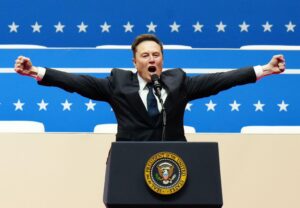
Elon Musk speaks in Washington after the second inauguration of Donald Trump. (Photo by Ken Cedeno/UPI/Alamy Live News, courtesy Bleecker Street)
Four hours of Elon Musk is — well, it’s a lot, you might think. A hotter take might be that it’s not enough.
As filmmaker Alex Gibney argues in his epic documentary Musk, the world’s richest man is using his historic wealth to impact global life on an incalculable scale. Unhurriedly and methodically, like a prosecutor building his case, Gibney casts Musk — who, in an on-brand fit of social-media pique, refused to sit down with Gibney to defend himself — as a comic book villain, a Doctor Octopus by another name, whose tentacles choke just about every major sector of life on our little blue dot and beyond: communications, through Starlink and X; artificial intelligence, through xAI; transportation, through Tesla and its self-driving electric vehicles; the cosmos, through SpaceX.
And then there’s DOGE, in which Musk treated the administrative state of the federal government in much the same way his employer erased the White House Rose Garden. In this context, wherein the film’s subject is arguably more powerful than any president or legislative body, Musk more than justifies its length. If anything, it is a brief snapshot in an ongoing cautionary tale of obscene wealth, stratospheric hubris, and the disastrous consequences of their combination.
Musk pivots on a central question Gibney poses in his prologue, in his customarily sober voice-over narration: “How could he assume so much power, and why had we given it to him?” The film proceeds in chapters, with titles like “Whiz Kid,” “Kublai Khan” and “Dark MAGA,” in a largely ignominious life. Gibney, perhaps weary of his project’s increasingly hulking scope, devotes scant attention to Musk’s upbringing in apartheid-era South Africa. Aside from a story his father, Errol, shares with Gibney about his son’s victimization by bullies and the father’s less than sympathetic response, Musk emerges as a fully formed golden boy in the Silicon Valley of 1998, where he has created Zip2, a kind of Yellow Pages for the early internet. He would sell the venture to Compaq a year later for $307 million. Even here, long before his villain era, Musk’s scruples come into question. In a resurfaced clip from this formative time, Musk brags to the camera about finding a workaround to leach the Web connection from a neighboring tenant in their building.
Gibney is most charitable to Musk in documenting his adventures in rocketry. As President Obama wound down what had become a moribund space shuttle program, Musk proved eager to let his private enterprise fill the vacuum. It took four dramatic attempts for Musk to successfully launch and return a rocket, at an expense that nearly bankrupted him, but in the process, SpaceX saved the federal government some $30 billion. Had Musk simply lost himself in space, he might still be viewed as a positive if eccentric figure — a dreamer who, in one early clip in Musk, expresses a philosophy of curiosity: “I just want to know what’s going on.”
Musk’s first major breach of morality, in Gibney’s telling, occurred when, upon his appointment as CEO of Tesla in 2008, he fired the company’s co-founder, pioneering engineer Martin Eberhard, and essentially confiscated his role in the company, legally deeming himself a founder of Tesla. Musk has coasted on this invention, abetted by a largely obedient media, for nearly two decades, as he grew Tesla into the dominant electric vehicle manufacturer. Gibney frames his subject’s ascent in the visually imaginative construct of a social-climbing video game, in which Musk’s knack for self-promotion, charisma be damned, allows him to scale one ladder of success after another.
Many are left behind in the rungs of his past, including numerous ex-wives, partners, and surrogate mothers (in a chillingly blunt turn of phrase, Justine Musk, his first wife, refers to Musk’s entourage of baby mamas as “breeders”) and the children that don’t comply with his worldview. You can almost hear Gibney seething through a segment on Musk’s eldest daughter Vivian Jenna Wilson, who came out as transgender in 2020 only to be disavowed, and deadnamed, by her father as a victim of “the woke mind virus.” Repeatedly, the women in Musk’s life appear as objects or annoyances — would-be employees he doesn’t have the power to fire.
While Gibney weaves an enormous amount of information in Musk, two chapters in particular consume enough screen time that they feel like the movie’s tent poles. In the first, aided by court depositions, hacked evidence, and an interview with a dogged attorney, Gibney breaks down the hype and rampant dishonesty of Musk’s AutoPilot and fully self-driving Tesla technology, which Musk promoted as a “solved problem” even while its errors have killed at least 60 people.
The second, which fills an outsized portion of the film’s considerably darker second half, concerns Musk’s radicalization toward right-wing politics, which first manifested during the pandemic and then in his allyship with Donald Trump, to whose 2024 re-election he credits himself. Through an interview with Ashley St. Clair, a former conservative influencer and mother to a child by Musk, Gibney even floats the idea of Starlink-aided interference in that election, pointing to Musk’s surety — not overconfidence, but surety — of the race’s results just as votes were being counted on election day. In a text thread Gibney presents, St. Clair wonders how Musk is so assured of the outcome, but she doesn’t ask him to elaborate for fear of being “deposed,” to which Musk responds with a single word: “Wise.”
We all remember what happened after Jan. 20, 2025: Musk’s indiscriminate bulldozing of 150,000 employees during the DOGE debacle. Hearing Samantha Power, the administrator of the United States Agency for International Development (USAID) from 2021 to 2025, discuss the disastrous effects — the estimated mass death — of Musk’s wholesale elimination of the agency is the film’s heartbreaking core.
But it is the cumulative effect of Musk, rather than one individual moment of clarity, that is so damning. Musk comes across as a figure starved of genuine, unconditional love from an early age, and who grew into a petty tyrant bent on forever justifying his value to an ever-skeptical populace. He is at times P.T. Barnum, distracting us with bright, shiny objects, but mostly he is Charles Foster Kane, building an empire to himself and running roughshod over anyone who stands in his way. But there is no Rosebud in Musk, no emotional talisman to better comprehend his mindset. He comes across as a hollow man propelled less by ideology than by his business interests; as Gibney reminds us, Trump’s victory over Kamala Harris ensured that most of the 32 Biden-era investigations into Musk’s companies were dismissed, scaled back or paused. As Gibney erects his four-hour argument, we begin to hate Musk more with each passing frame.
Certainly, Musk is a work of directed anger. It could have been more magnanimous, you might say — a “balanced” take more in line with Walter Isaacson’s biography Elon Musk. Gibney could have interviewed Isaacson as a counterweight to the chorus of talking heads, such as Kara Swisher and Sam Harris and the many people in life that Musk has personally wronged, who obviously have an adversarial perspective about the man. And Gibney’s repeated deployment of the aesthetic of a first-person shooter video game to illustrate Musk’s vaporization of employees, whether at Twitter/X or the federal government, is a bit much.
Yes, Gibney would have tempered his reporting, but it wouldn’t have had the same justifiably ferocious bite as the final work, whose crushing totality is its own collective counterpoint to the fawning coverage Musk has skated atop for most of his adult life. Gibney understands the danger Musk poses — to the midterm elections, to the war in Ukraine, to our very existence in an environment of increasingly rogue AIs — and in this environment, Musk attempts to put a flamethrower to the five-alarm fire that’s still unfolding around us. It might be imperfect, but to call it the year’s most vital film is an understatement.
MUSK. Director: Alex Gibney; Distributor: Bleecker Street; Rated R; now playing at CMX Cinemas Downtown at the Gardens in Palm Beach Gardens and Regal Royal Palm Beach