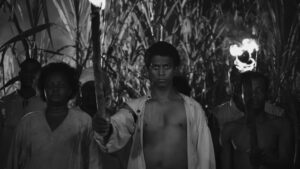
Zombies have become such a ubiquitous trope in American culture that most of us don’t ponder their evidently racist and xenophobic origins. In her first feature-length documentary, Black Zombie (Kino Lorber, $29.95 Blu-ray, $19.51 DVD), Canadian director Maya Annik Bedward methodically builds a case for the zombie as a fundamentally corrupted and co-opted vestige of Western colonialism.
Bedward combines interviews with academics, film historians, Vodou practitioners and zombie enthusiasts with animations, augmented photographs, movie clips and black-and-white re-enactments. She identifies the first usage of “zombie” in the occultist and adventurer William Seabrook’s 1929 book The Magic Island, a pivotal harbinger of a century of zombie lore. Seabrook, a white man, traveled to Haiti to document the country’s Vodou rituals, which he linked with the capacity, present in the nation’s folklore, to reanimate the dead. The book became a sensation and led to its own film adaptation that painted the zombie as a soulless, mindless victim of sorcery perpetrated by a culture of savages.
As Bedward explains, it wasn’t until the mid-to-late 20th century that the horror industry, spearheaded by George A. Romero, reinvented the zombie as a flesh-eating scourge detached from Haitian Vodou. But the concept’s original sin, as it were, resurfaced in 1985 with The Serpent and the Rainbow, Canadian anthropologist Wade Davis’s best-seller. The Serpent, both in print and film, in which Bill Pullman portrayed Davis, revisited the odious ideas disseminated by Seabrook, exploiting the religion of a Third World country through the shopworn device of a white-savior story.
The film clips Bedward selects to illustrate her thesis are revelatory, whether chosen from a 1940s B picture, the cringey Caribbean cultural appropriation of Live and Let Die, or a bona fide classic such as Night of the Living Dead, where, pointedly, the movie’s Black protagonist, after surviving the zombie horde, is taken to be an undead person himself and unceremoniously gunned down by white police officers.
There are moments of levity in Black Zombie. Bedward interviews the organizer of a zombie walk as well as a hardcore zombie fan, whom Bedward films applying rotting makeup to her face and shuffling into a gas station to amuse or terrify the employees.
But her main points are sobering and revelatory. For many Haitians, the term “zombie” has become inextricably linked to “slave,” owing to Haiti’s sugar plantations, in which 500,000 indentured people — deprived, like zombies, of agency, of autonomy, of a voice — toiled under 30,000 colonists during the French occupation of Hispaniola. Haitians led an insurrection to end French colonial rule in 1804, but as Bedward reports, the Haitian Revolution has been erased from standard French history texts. Black Zombie is an argument, it’s a corrective, it’s a college course distilled into 93 minutes. But more than anything, it’s a paean to a nation’s history of resistance and to the establishment of its power and self-determination.
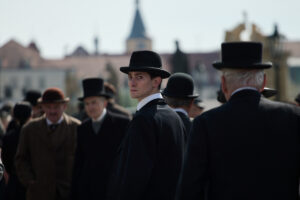
Franz (Cohen Media, $21.92 Blu-ray, $13.92 DVD), Polish director Agnieszka Holland’s biopic of Franz Kafka, is nothing if not ambitious. While mostly settling on a linear narrative of Kafka’s career and love life, Holland, working from a screenplay by Marek Epstein, inserts obtuse black-and-white fantasias, flashbacks to the writer’s youth in a boisterous domicile in Czechoslovakia, and flash-forwards to present day, where tour guides explore Kafka’s homes and memorials in various languages. At one point, Kafka, played with an uncanny resemblance by Idan Weiss, finds himself trapped in his namesake Prague museum in the 2020s, transfixed by the prying eyes of his future admirers. Often, characters break the fourth wall to share thoughts or reflections on Kafka to the camera, as if interviewed for a documentary.
Through these unusual devices, Holland effectively keeps her viewers off balance while painting a prismatic portrait of her slippery subject. But its self-conscious flourishes cannot compensate for the nagging persistence of Kafka’s inscrutability. Despite his exhaustively researched existence — 10 million words have been spilled about Kafka, compared to the 1 million he wrote in his 40 years on the planet — the conclusion Holland conjures in 127 minutes is that her protagonist was a cipher. And ciphers seldom make for compelling drama.
If there is a consistent through-line in its scattershot probing of Kafka’s psyche, it’s of the writer’s eternal desire for silence. We see him endeavoring to put ink to paper while living in the unbearably noisy home of his Ashkenazi Jewish family, led by domineering and boorish patriarch Hermann (Peter Kurth). We get a vague sense — too little, given the dominance of the bureaucratic state in his writing — of his soul-deadening day-to-day existence at an insurance firm. There’s a recurring focus on his tortured relationship with women, first to lower-class Berliner Felice Bauer (Carol Schuler), then to Felice’s friend Grete Bloch (Gesa Schermuly), and, toward the end of his life, to Milena Jesenská (Jenovéfa Boková), a Czech journalist, presented as the only partner with whom Kafka expressed a physical passion.
Holland finds time for curious detours as well, including to Kafka’s sister’s frayed marriage, and to his uncle’s adventures in barbarous dentistry. As his eventually fatal tuberculosis diagnosis begins to manifest, we see Kafka admit himself to a sanatorium run by an eccentric nudist keen on calisthenics. Here and elsewhere, the film offers flopping penises aplenty, each of which seem geared to elicit a gasp from the provinces.
You don’t have to be a Kafka head to desire more from Franz, which includes lots of information but scant context, and scarcely little of the writer’s bold narrative ideas. For all of its experimental asides, the film is, at its core, all too conventional, content to throw up its hands regarding the elusive inner life of the enigmatic writer while making only vague notions toward the crass commercialization of his genius.