Where has The Shout been all my life?
It’s taken 25 years into my personal moviegoing odyssey, thanks to a sparkling new edition from Criterion ($31.96 Blu-ray), to discover that Jerzy Skolimowski’s slippery 1978 psychodrama may as well have been engineered in a lab to satisfy my taste in 1970s arthouse cinema. In combining the wide-open spaces and enigmatic existentialism of Antonioni with the disorientating editing rhythms of Nicolas Roeg and the sexual disjunctures associated with both directors, The Shout is the ur-’70s movie, a mesmerizing capstone to an era in which the director was king, narrative coherency was optional, and studio budgets supported niche visions.
Based on a short story by English novelist and poet Robert Graves, The Shout is set, initially and intermittently, on the cricket field of a psychiatric hospital in North Devon, a dreamlike set piece in which the patients compete in the bat-and-ball game while cows and peacocks roam freely around them. Tim Curry’s Robert Graves (a nod to the source material) arrives to judge the match alongside one of the asylum’s highest-functioning residents, a brooding man named Crossley (Alan Bates) who is described by the hospital staff as “not entirely normal.” “What’s normal?” rebuts Graves.
We’ll soon parse this distinction, as Crossley finds a sympathetic ear in the visiting scorekeeper, sharing his backstory with a caveat: “It’s always the same story, but I vary the climax a little. I like to keep it alive.” Most of The Shout flashes back to the main plot, set in a country estate nearby, where John Hurt’s Anthony Fielding, an avant-garde composer and church organist, lives with his wife Rachel (Susannah York). While Anthony performs at the local chapel, Skolimowski cuts to the hand of an unseen visitor deflating the wheels of Anthony’s bicycle. This is the work of Crossley — philosopher, spiritualist, looking ever the cult leader with his self-serious mien and long, dark overcoat — setting the trap for his mark.
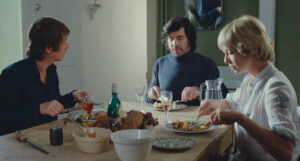
The two men speak of theological matters outside the church, and Anthony offers him a meal at their house. As Crossley sits down at their dining room, he reveals that he hasn’t eaten in two days, that he spent 18 years wandering the Australian outback, and that he studied sorcery from the aboriginals. In fact, he says, with the aid of a voodoo-like bone he carries with him, he can point it at his victim and kill them with a shout.
Because we see Crossley interacting with a number of people in two settings, we can only assume he is a flesh-and-blood person. But Bates’ chilling performance suggests a phantom, an apparition, a shadow figure from some parallel time, with an unfathomable past and an unforeseeable future.
For a materialist like Anthony, surely no man can stop another’s heart with a sound, no matter how loud or directed. He wants to hear the scream for himself. Will the curiosity kill the composer?
The sound design is pivotal to The Shout. Anthony’s interest in his new ward’s skill is especially intriguing because he specializes in musique concrète, creating alien sounds in his studio from such instruments as sardine cans, alarm clocks, rolling marbles, and even the hair of his Labrador. Meanwhile, the movie’s nondiegetic score, by Tony Banks and Mike Rutherford of Genesis, is unobtrusive and often absent. The Shout is largely a quiet movie, such that every sound is startling. By the time we hear Crossley let loose with his otherworldly howl, it is one terrifying emanation in a soundtrack of pervasive eeriness.
In a supplemental interview for the Criterion disc, Skolimowski comments that the premise of the murderous shout, which is so central to Graves’ short story of the same name, didn’t interest him much, and that he saw, and filmed, The Shout as a “perverse psychological drama.” Indeed, the shout is heard but once, and it’s just one tool in Crossley’s kit of sinister persuasion. While insinuating himself into the Fieldings’ lives, he deploys other methods to control their minds, treating Rachel like his personal marionette and rendering Anthony a cuckold.
Even when Crossley isn’t present, he seems to affect his quarries’ reality through a quantum field. The longer he works his black magic, the more The Shout unmoors itself from reality. Comprehension takes a backseat to atmosphere and implication. It’s as if Crossley hijacks the movie’s direction, and we become as spellbound by his witchcraft as do Rachel and Anthony.
Despite its harrowing passages, The Shout isn’t a horror movie; it’s too cerebral, too experimental and acid-washed, to indulge in the genre’s requisite scares. It’s perhaps best to read The Shout as a study of alienation and marital disintegration — think Bergman, think Antonioni, think Rossellini — in which Crossley isn’t so much a person as a virus inserted into the couple’s union, metastasizing with every passing minute.
In the best of the disc’s supplements, producer Jeremy Thomas and Skolimowski, now 88, share the origins of The Shout in new interviews. The director, on the heels of another project that fell through, had been living week-to-week in a hotel, desperate for a new project, ordering, as he recalls it, the cheapest omelet in the room-service menu. Thomas pitched Skolimowski The Shout, hoping, correctly, that the Polish auteur would tamp down the overwhelming Britishness of Graves’s story.
In a humorous anecdote, Skolimowski recalls asking Jack Nicholson for his casting recommendations for Crossley. Nicholson’s cryptically on-brand response: “Get a man with a neck.” Thick-necked Alan Bates certainly fit the bill.