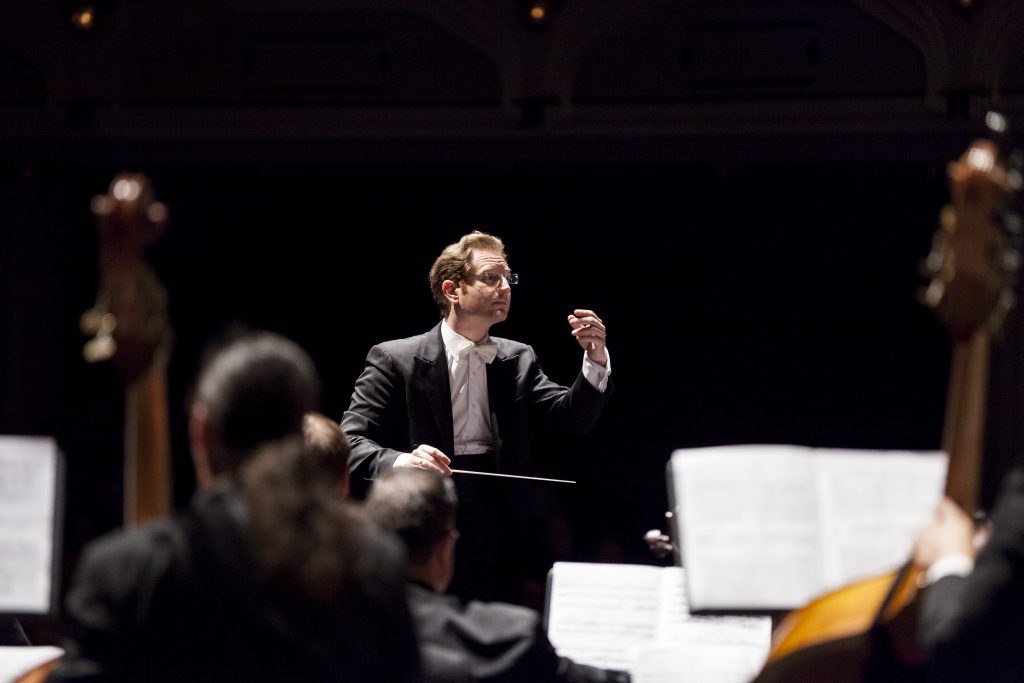
Ramón Tebar conducts his orchestra like a man fine-tuning a grand piano. Responding to his every command, even the slightest hand gesture, the refined playing of the Palm Beach Symphony in its last concert of the season Thursday night at the Kravis Center was superb.
Tebar is proving to be more than a fine orchestra builder. His conducting and orchestral control is comparable to many of the greats I have seen in my lifetime: John Barbirolli, Charles Munch and his own late countryman Enrique Jorda.
It would not surprise me if one of the big-city orchestras, here or in Spain, come calling soon. What he has done for this orchestra is no less than Herculean, growing it from a small chamber group, framing its size to match their many venues and their odd acoustic, reveling in the orchestra’s capacity to do big works when up to full symphonic strength.
Giving time to the works of Shostakovich and composers of South America suggests he is open to expanding his and the orchestras’ repertoire into the yet unexplored realms of musical delights not heard. Thursday’s all-Russian concert opened with Rachmaninoff’s Vocalise, the final addition to the composer’s own transcription for orchestra of 14 songs written in 1915. Once heard, this immortal tune took on a life of its own by combining the elegance of a Baroque aria with all the emotion of the composer’s own late Romantic language. The soft, refined playing was sensitive and quite lovely: conductor and orchestra were as one.
Stravinsky’s ballet music for The Firebird, fashioned by him into a concert version when he got to America in 1939, came next. Serge Diaghilev hired Stravinsky at the last minute when a fellow composer failed to deliver for the Paris season of 1910 of the Ballet Russes. It was a huge success. Stravinsky went on to write other epic works for the Ballet Russes, Petrushka and The Rite of Spring.
One could say these three works created modern classical music as we know it today: Stravinsky set the tone for years to come. Beginning with a mysterious, brooding introduction emerging from the lower strings the Firebird appears with intense trills — flapping her wings — caught by a prince, her pleas to be released are shown in long languid phrases that capture the mood perfectly. Over the next 11 movements, each section head shone as they soloed or led their players in this magnificent music.
Tebar’s control was amazing. Each melody seemed to emanate from his fingertips, the chromatic strains contrasting serenely with the supernatural elements of the music. This idyll is jolted by one of the loudest sudden orchestral “bangs” ever heard in the concert hall, guaranteed to wake sleepers all around. From then on, the music romps home with infernal dances, with pounding realism from the timpani building to a thunderous affirmation.
I was riveted during the playing of this great work and for the first time realized and appreciated Stravinsky’s groundbreaking orchestration, thanks to the careful treatment Maestro Tebar gave every note. The full house at the Kravis Center gave the orchestra a standing ovation, each section deservedly taking a personal bow.
Tchaikovsky’s Sixth Symphony (in B minor, Op. 74) ended the program. It would be his last great work. Written in 1893, having scrapped an earlier attempt to write “a grand symphony,” he wrote to a nephew saying the form of the Sixth Symphony would have much that is new and that the last movement would not be a noisy allegro but a long, drawn-out adagio. One has to wonder if he had intimations of mortality, since nine days after conducting the premiere of this glorious work in St. Petersburg, he died suddenly at 53.
The adagio is indeed a dirge, full of deep passionate music that earned the symphony the descriptive word “pathétique,” a title suggested by his brother, Modest. The Palm Beach Symphony gave it a warm, respectful reading, every section playing to the highest standards, each the sum of this splendid whole which met another standing ovation as the dirge died away.
But it was Tebar’s night. He must be justly proud of the fine ensemble he has created in the 85 players that made up the orchestra at the Kravis Center on Thursday.