By Robert Croan
The blockbuster First Piano Concerto of Pyotr Ilyich Tchaikovsky was the featured work on South Florida Symphony’s season opener at The Parker [Nov. 11]. This staple of the repertory is a surefire crowd pleaser, and the soloist, Canadian pianist Sheng Cai, was rewarded with a large ovation that elicited an encore – a flashy Spanish-style piece by Polish composer Moritz Moszkowski – just before the intermission.
Cai’s playing was technically quite spectacular. He tossed off the most difficult chordal and arpeggiated melodies with breakneck speed and accuracy. His fingers never tired and there was nary a noticeable missed note. This showed him to best advantage in the pervasive fast and furious passagework of the opening movement, which contains the concerto’s most familiar music. He lacked legato for the beloved broad melodies, however. Their effect was diminished by his weighty, note-by-note, chord-by-chord approach — most damaging in his monochromatic and pedestrian execution of the delicate middle movement.
The pianist came back into his own in the rousing Allegro finale, reveling in its loud-and-fast digital difficulties, and bringing many in the audience to their feet at the end.
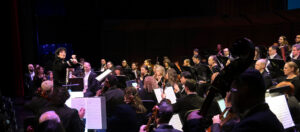
The concerto was not conducted by music director Sebrina Maria Alfonso, but by concertmaster Huifang Chen, who also serves as the orchestra’s associate conductor. Chen is a superlative musician, as proven not just by her violin work over the years but also in her supervision of SFSO’s invaluable summer chamber music series. As a conductor, she did everything required for the concerto: she kept the ensemble in sync with the soloist, and brought out innumerable details in the purely orchestral passages.
Alfonso had opened the program with a valiant account of Brooklyn-born Jennifer Higdon’s brief yet evocative “Cathedrals,” the last of four musical sketches inspired by America’s national parks. Higdon’s soundscape is vibrant and evocative, her aural kaleidoscope of instrumental color contrasts demanding multiple subtleties from the instrumentalists, which Alfonso conjured up with conviction in this rendition. The 64-year-old composer is one of the most interesting, original — and accessible — among living American composers. The present performance made one wish for the suite, called All Things Majestic, in its entirety.
The conductor turned to a larger challenge on the second half: Shostakovich’s neglected and often disparaged Symphony No. 12. A response to the Soviet regime’s restrictions on artistic freedom during the Khrushchev era — subtitled “The Year 1917” — this work is in fact a moving musical tribute to Vladimir Lenin, in four continuous movements, each depicting an aspect of the Russian leader’s accomplishments.
It’s musically intricate and subtly delineated, arguably more so than the composer’s previous and more celebrated 11th Symphony (which is quoted in the newer work), and Alfonso was right to champion it in this all-too-rare revival. It was obviously a labor of love for this conductor, who brought out the agitation of the opening “Revolutionary Petrograd” movement — depicting freedom from tsarist repression — immediately contrasted by the soft serenity of “Razliv,” depicting preparation for the revolution. This work is an acid test for any orchestra, and Alfonso elicited her troupe’s best work.
The fleeting scherzo-like “Aurora,” signaling the historic assault on the Winter Palace, led to the overtly jubilant “Dawn of Humanity” finale — celebrating Lenin’s self-described “new society.” In its early performances, this did not earn the work the acceptance and accolades it deserved from hostile Western countries. Alfonso made an excellent case for this underrated piece, communicating her love for this music and her accomplishments with her ever-progressing South Florida ensemble.