By Robert Croan
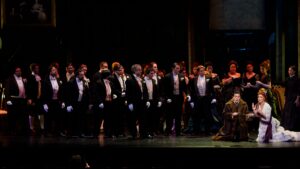
To open Florida Grand Opera’s 85th anniversary season, general director Maria Todaro revived the opera that inaugurated the company, Donizetti’s Lucia di Lammermoor [seen Nov. 15 at Miami’s Ziff Ballet Opera Theater].
It’s a tuneful bel canto perennial based on Sir Walter Scott’s novel about a young Scottish woman driven to madness by being forced to marry a man she doesn’t love. With a Gothic Masterpiece Theatre-like set by Ryan McGettigan and inventive lighting by Al Crawford — plus the extraneous physical presence of a ghost that only exists in the heroine’s deranged mind — British director Neil Robinson staged the work to emphasize the tragic aspect of a woman for whom almost every choice has been made by coercion.
This was also the debut of the newly formed FGO Orchestra, deftly led by music director Pablo Mielgo (formerly conductor of Fort Lauderdale’s Symphony of the Americas). The orchestral playing was particularly gratifying, especially in the Act 1 interlude featuring harpist Giuseppina Ciarla. But it’s the singers who count most in this opera, and Mielgo was always with them. Lucia contains two of opera’s greatest hits. Aficionados await the rousing Act 2 sextet, the characters simultaneously expressing contrasting emotions in an unforgettable melodic outburst; as well as Lucia’s iconic mad scene, a 20-minute tour-de-force that exploits just about every possible vocal challenge.
In the title part, soprano Marnie Breckenridge sang with a smallish sound that did not match her bigger-voiced male colleagues, but she rode the role’s technical challenges with ease and accuracy. Hardly a note out of place: high or low, in fast roulades or spun-out lyrical lines, she made her music seem effortless and natural. Fragile and delicate in demeanor, she created a character sufficiently off-kilter to be slightly scary from the start. She was more effective in solos than ensembles — her entrance cavatina-cabaletta, and of course, the blockbuster mad scene.
The three male leads were indeed a high-powered assemblage. In the mid-19th century, when Lucia was new, it was considered a tenor’s opera. It’s an interesting sidelight that in a 1961 FGO production, a 29-year-old Luciano Pavarotti, making his American debut as Lucia’s lover Edgardo, is said to have stolen the wind from super-diva Joan Sutherland.
In the present cast, Arturo Chacón-Cruz took top honors as well. A dashing, Jane Austen-type hero on stage, he poured out gorgeous tone, full and baritonal in the middle range, bright and gleaming in his high notes, coloring his words to the meaning of the moment. Following Lucia’s mad scene, Edgardo’s big solo turn can seem anticlimactic. Not so here. His delineation of the recitative at his parental tombs made every word count; the aria “Fra poco a me” was a lesson in legato, and his final suicide lines, soaring higher and higher with no apparent strain or struggle, were as viscerally thrilling as they were emotionally heart-rending.
In a different way, baritone Daniel Scofield’s Enrico gave visceral thrills by the sheer volume and power of his sound. His in-your-face vocalism worked well in projecting the crude, unlikable character who is the catalyst for the tragedy. His high note at the end of Scene 1 was staggering, as was another at the climax of his Act 2 duet with Lucia.
As the callous Calvinist chaplain Raimondo, veteran Greer Grimsley proved that at 70 he retains control of his vocal resources, along with a textual authority that came through in the re-insertion of the character’s traditionally cut scena preceding the wedding.
Smaller roles were adequately filled by 2026-27 studio artists Alla Yarosh (Alisa), Levi Adkins (Arturo) and Chris Melton (Normanno). The chorus, prepared by Jared Peroune, was plush in sound and well-managed on stage.